About the YMSA Competition
The Young Mathematical Story Authors (YMSA) competition is the world's first annual international competition set up to encourage young mathematics learners (4-16 years old) from around the world to embed their mathematics learning in a meaningful and engaging context through creating their own mathematical story picture books. This competition is organised by MathsThroughStories.org, and it has been running every year since 2019. Since then, the competition has received entries from almost 4,000 students across over 260 schools in 23 countries.
The competition's social media hashtag is #YMSAMaths.
Details of our brand new entry category (4-7 years old) will be available soon!
Judging Panel
In addition to Dr. Natthapoj Vincent Trakulphadetkrai (Founder of MathsThroughStories.org and Associate Professor of Mathematics Education at the University of Reading, UK), our judging panel also includes two of the world's most prolific and best-selling mathematical story authors, Stuart J. Murphy and Cindy Neuschwander. Both Stuart and Cindy have also kindly agreed to let us name our annual awards for the winners of the 8-11 and 12-16 age group categories as The Stuart J. Murphy Award and The Cindy Neuschwander Award respectively.
The competition's social media hashtag is #YMSAMaths.
Details of our brand new entry category (4-7 years old) will be available soon!
Judging Panel
In addition to Dr. Natthapoj Vincent Trakulphadetkrai (Founder of MathsThroughStories.org and Associate Professor of Mathematics Education at the University of Reading, UK), our judging panel also includes two of the world's most prolific and best-selling mathematical story authors, Stuart J. Murphy and Cindy Neuschwander. Both Stuart and Cindy have also kindly agreed to let us name our annual awards for the winners of the 8-11 and 12-16 age group categories as The Stuart J. Murphy Award and The Cindy Neuschwander Award respectively.

|
Stuart J. Murphy (Massachusetts). With 63 mathematical stories under his name and a total volume of 18+ million copies of his MathStart series sold worldwide, Stuart is the world's most prolific and best-selling mathematical story author. Stuart is also the author of I See I Learn, a series of 16 books that teach social, emotional, health and safety, and cognitive skills to young children. In addition, he is also a member of the authorship teams of a number of mathematics programs published by Savvas Learning (formerly Pearson Education), including enVisionMATH, a top-selling comprehensive elementary mathematics program.
|

|
Cindy Neuschwander (California). Cindy has authored all 10 titles in the very well-established and much-loved Sir Cumference series. She is also the author of three other titles in a separate series following mathematical adventures of Matt and Bibi ('Mummy Math: An Adventure in Geometry', 'Pastry School in Paris: An Adventure in Capacity' and 'Patterns in Peru: An Adventure in Patterning'). Additionally, Cindy also contributed to other mathematical series, namely ‘Amanda Bean's Amazing Dream’ (Marilyn Burns Brainy Day Books series) as well as '88 Pounds of Tomatoes' and 'The Chocolate Champs' (Hello Math Readers series).
|
Judging Criteria
- Ability to explain the chosen mathematical concept in the story clearly without assuming readers' knowledge of the concept
- Ability to embed the chosen mathematical concept in a meaningful context
- Ability to show how characters' knowledge of the chosen mathematical concept can help them solve a problem(s)
- Ability to represent the chosen mathematical concept contextually (in words), visually (via page illustrations showing the mathematical problem-solving process), and symbolically (via using correct mathematical symbols, notations and language)
- Accuracy of mathematical concepts presented in the story
- Ability to come up with an engaging and original story
- Gender and ethnicity balance in characters
- Overall presentation and standard of writing (e.g. quality of illustrations, the use of punctuation, spelling, etc.)
(For the 12-16 years old entries, please note that your chosen mathematical concept must be about what you are currently learning, for example but not limited to, algebraic functions; exponential growth; powers and roots; more advanced probability and statistics, etc.). Entries for the 12-16 category that focus on basic mathematical concepts, for example, but not limited to, addition, multiplication, simple fractions; and basic properties of 2D shapes, will all be excluded. Please also note that we have received many entries with the focus on Pythagoras' Theorem, trigonometry and bearings in each year: you are therefore strongly encouraged to choose a different mathematical concept beyond these three concepts to make your entries stand out more.)
Key Dates
- Entries open - Monday 6th January 2025
- Closing date for entries - Friday 21st March 2025 (17:00 UK time)
- Results publicly announced - Friday 30th May 2025
Awards
- The winner in our youngest entry category (4-7 years old) will receive an award of £50, and their school will also receive £50. (In case of homeschooled children, if they won, they would get £50 and their nominated local public library would too get £50.)
- The winner in each of our two older entry categories (8-11 and 12-16 years old) will receive an award of £100, and their school will also receive £100. (In case of homeschooled children, if they won, they would get £100 and their nominated local public library would too get £100.)
- The winner will also have their own profile, their school and their winning entry featured on the MathsThroughStories.org website. (Since its launch in March 2017, the website has been visited over 1,500,000 times by around 430,000 teachers and parents from more than 220 countries around the world.)
|
Sponsors
The Stuart J. Murphy Award and the Cindy Neuschwander Award are generously sponsored by HarperCollins and Charlesbridge respectively. This is the seventh year that these two major publishers support our YMSA competition. HarperCollins is the publisher of MathStart, the world’s largest mathematical stories series authored by a single author (Stuart J. Murphy), and Charlesbridge the publisher of Cindy Neuschwander’s very successful Sir Cumference series. |


|
|
Outreach Partners We are grateful to our Outreach Partners in various countries for promoting our competition to Mathematics teachers and students in their respective countries. Please get in touch if you would like to become our Outreach Partner. |

|
Supporting Resources for Students
In collaboration with our judges, we are pleased to share the following supporting resources: our mathematical story writing guideline here, our mathematical storytelling mind map and storyboard here, and our suggested mathematical story picture book template here.
Concerning the template, the story structure found in the template is only one of many possible story structures. Stories that do not follow this suggested story structure will still be considered. Please use this template to help your students/child with their story planning. The final version of their story should then be neatly transferred onto clean / blank A4 sheets of paper.
Examples
Other ways that you can support your students/child is to encourage them to read as many as possible past successful YMSA entries which are accessible via the links below.
- Winning and shortlisted entries from 2024 can be found here.
- Winning and shortlisted entries from 2023 can be found here.
- Winning and shortlisted entries from 2022 can be found here.
- Winning and shortlisted entries from 2021 can be found here.
- Winning and shortlisted entries from 2020 can be found here.
- Winning and shortlisted entries from 2019 can be found here.
Entry Requirements (Please read carefully)
- There are two entry categories: 8-11 years old and 12-16 years old. (If your student's age is 11.5 years old or older, please enter them in the 12-16 years old category.);
- Entries must genuinely represent the work of the students (and not of their teachers or parents);
- Each student can only submit one entry, but there is no limit to the number of entries per school;
- Only 'individual' entries are currently possible (i.e. one student/author per story). 'Team' entry is not possible at this stage;
- Entries can be submitted by students from anywhere in the world, but the entries must be submitted in standard English;
- Each entry (or story) should clearly focus on one mathematical topic;
- Where possible, students' own drawings are strongly encouraged to avoid any copyrights issues;
- The entry (or story) can be written in any sub-genre of fiction (e.g. fantasy, detective, thrillers, action, mystery/adventure, ghost story, humour, science fiction, fairy/magical tale, myths or legends, etc.);
- All entries must not exceed 8 A4 pages (excluding front and back covers) - consider using our suggested mathematical story picture book template (see the above section);
- The front cover must contain: 1) the story's title; 2) the names of the author and their school. (If homeschooled, please indicate so);
- All pages should be numbered (excluding front and back covers);
- All entries should be submitted in the 'portrait' / vertical format (as opposed to the 'landscape' / horizontal format);
- All entries must be submitted electronically as a PDF file. (Tip: Anything written or drawn by regular pencils, once scanned, will be very hard to read and see. On the final draft, consider writing over your text and outlining your drawings with a felt-tip pen);
- All entries must be submitted by the student's teacher. (For homeschooled children, the entries can be submitted by their parent);
- The file name of all entries must be saved in the following format: School's name_Author's first nameAuthor's last name_Author's age_Author's gender (e.g. LondonPrimarySchool_DavidSmith_9_Male).(For homeschooled students, simply replace the school's name with 'Homeschooling' in the file name. Concerning the author's gender, the author can choose 'Male', 'Female', 'Non-binary' or 'Undisclosed' in the file name.
- In your submission e-mail, feel free to indicate if students have any cognitive/learning disabilities that you would like the judges to take into account.
- All entries must be submitted to [email protected] by the stated deadline. (If your school is submitting several entries [e.g., 20+ entries], please feel free to upload the files onto either Google Drive, Dropbox or Microsoft OneDrive, and simply send us the URL link to access / download the files ourselves.)
If these entry requirements are not met, we reserve the right to exclude the entries in question from the competition.
|
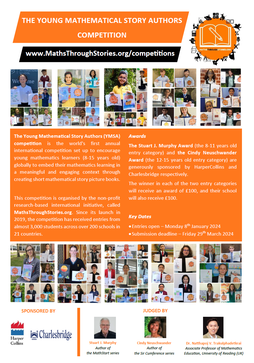
The YMSA Competition Poster To help promote this competition to students at your school, we have created a poster PDF for you to either e-mail to students and their parents or/and have the poster displayed around your school. The 2025 YMSA poster PDF will be available for downloaded soon! Inclusiveness: Please do not feel like you have to initially select and send us only the strongest few entries from your school. In fact, we would encourage you to forward to us all the entries from all your students to ensure that all students feel that they are equally included as part of the competition. (It is very common for us to receive 50-300 entries from each school, for example.) |
|
Terms and Conditions
For more information of this competition, please contact us here.
- Our judges' decisions are final;
- Due to the expected volume of submitted entries, we are unable to provide feedback for unsuccessful entries;
- Unsuccessful entries, with further improvements, can be submitted again in the following year's competition;
- By submitting your pupil's / child's entry, you guarantee that the work is of their own creation and no part of the work has been plagiarised from the work of others or includes the creative involvement of others;
- By submitting your pupil's / child's entry, MathsThroughStories.org is permitted to use the submitted entry for our research, and to help promote our future competitions as well as the works of our organisation in general.
For more information of this competition, please contact us here.